
 English

 |


| Quantity: | |
|---|---|
An aluminum circle (or aluminum disc) is a pre-cut, round blank of aluminum alloy that is specially manufactured to be drawn and formed into the inner cooking pot (or inner bowl) of a rice cooker. It is the fundamental raw material that undergoes a series of processes to become the pot you see.
These are not just any pieces of aluminum; they are engineered with specific alloys, tempers, and surface finishes to perform perfectly in the demanding environment of a rice cooker.
Excellent Thermal Conductivity: This is the most critical reason. Aluminum heats up quickly and evenly distributes heat across the entire cooking surface. This prevents hot spots that can cause rice to burn in one area while being undercooked in another, ensuring perfectly cooked rice every time.
Lightweight: Aluminum is much lighter than alternatives like stainless steel, making the rice cooker pot easy to handle, clean, and remove from the base.
Cost-Effective: Aluminum is abundant and relatively inexpensive to process, which helps keep the overall cost of rice cookers affordable.
Formability: Aluminum alloys can be easily pressed and drawn into complex shapes without cracking, which is perfect for creating the deep, seamless bowl of a rice cooker.
The journey of an aluminum circle into a rice cooker pot involves several precise steps:
Blankning: A large coil of aluminum sheet is fed into a punching machine that stamps out perfect circles of a specific diameter and thickness.
Drawing/Stamping: The aluminum circle is placed in a hydraulic press. A powerful punch forces the disc into a die, stretching it into a deep, cup-like shape. This often requires multiple drawing steps to achieve the final depth without tearing the metal.
Trimming: The uneven top edge of the drawn pot is trimmed off to create a smooth, uniform rim.
Surface Treatment (Anodizing): This is a crucial step for most modern rice cookers.
Non-Stick: Prevents rice from sticking, making cleaning effortless.
Durable: Highly resistant to scratching and abrasion from spoons and scoops.
Corrosion-Resistant: Protects the underlying aluminum from reacting with food and water, which can cause pitting and off-flavors.
Non-Toxic: Creates a inert barrier, so aluminum does not leach into the food.
Hard Anodizing: The pot is electrochemically treated to create a thick, hard, and non-porous layer of aluminum oxide on the surface. This coating is:
Coating (Optional): Some pots receive an additional ceramic-based or PTFE (though less common now) non-stick coating applied over the anodized layer for even better release properties.
When manufacturers order aluminum circles for rice cookers, they specify:
Alloy: The most common alloys are from the 1000, 3000, and 4000 series (e.g., 1050, 1100, 3003, 3004, 4343). These alloys offer a good balance of formability, strength, and thermal conductivity. 3003 is a very popular choice.
Temper: Usually supplied in H24 or H18 temper. H24 is a half-hard temper that provides a good balance between formability (for the deep drawing process) and final strength.
Thickness: Typically ranges from 1.5mm to 3.0mm. Thicker circles are used for higher-end models as they provide better heat retention and more durability.
Diameter: Varies according to the size (capacity) of the rice cooker, commonly from 16cm to 26cm.
Surface Quality: The surface must be clean, smooth, and free from scratches, impurities, or rolling marks to ensure a perfect final coating.
Uniform Performance: Ensures even cooking by eliminating hot spots.
Energy Efficient: Heats up quickly, reducing cooking time and energy consumption.
Durable End-Product: When hard-anodized, the final pot is very long-lasting.
Excellent Non-Stick Base: The smooth metal provides a perfect surface for anodizing and other non-stick coatings.
Avoid Scratches: Never use metal utensils on the inner pot, as they can scratch the non-stick anodized or coated surface.
Clean Gently: Use soft sponges and mild detergents. Abrasive cleaners will damage the surface.
Safety: The hard-anodized layer is completely safe and non-reactive. It creates a stable barrier between the food and the aluminum metal
In essence, the aluminum circle is the unsung hero of your rice cooker. This specially engineered disc of metal, through advanced forming and surface treatment, becomes the high-performance, non-stick, and durable inner pot that is fundamental to cooking perfect rice. Its superior heat distribution is a key technology that makes automatic rice cookers so effective and reliable.
If you are involved in sourcing or manufacturing, paying close attention to the alloy, temper, and thickness is critical. For everyday users, understanding its role highlights the importance of caring for the inner pot properly.
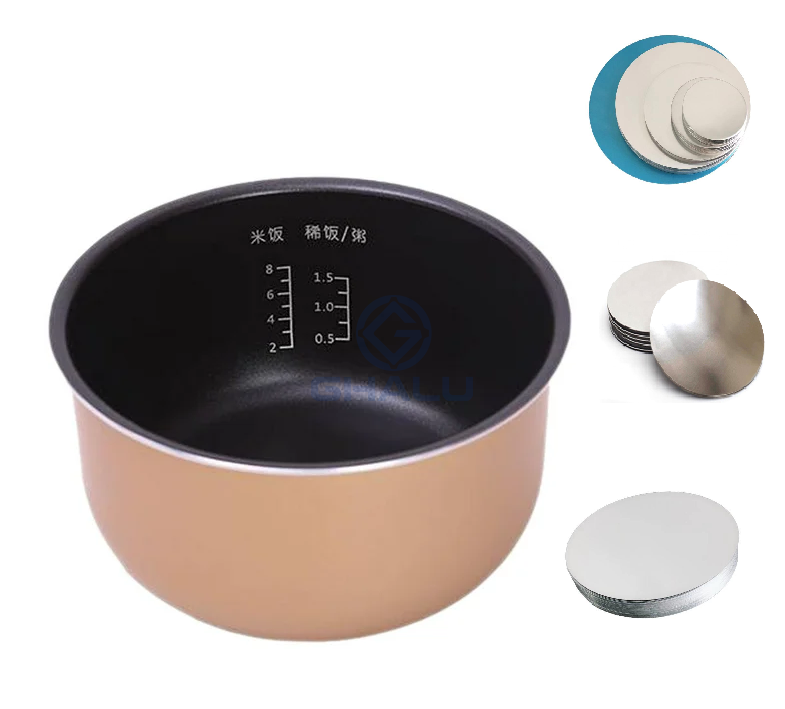
Aluminum 3003 is one of the most popular and suitable alloys for deep-drawn applications like rice cooker pots due to its excellent combination of formability, strength, and thermal properties.
The composition is the fundamental reason for its properties. Key elements include:
| Element | Content (%) | Role in the Alloy |
|---|---|---|
| Aluminum (Al) | Balance (~97%) | Base metal, provides corrosion resistance and conductivity. |
| Manganese (Mn) | 1.0 - 1.5% | Primary alloying element. Increases strength and work hardening without significantly sacrificing formability. |
| Copper (Cu) | 0.05 - 0.20% | Slightly increases strength. |
| Iron (Fe) | ≤ 0.7% | Impurity, controlled to maintain formability. |
| Silicon (Si) | ≤ 0.6% | Impurity, controlled to maintain formability. |
| Zinc (Zn) | ≤ 0.10% | Impurity. |
| Others (Each) | ≤ 0.05% | - |
| Property | Value / Description | |
|---|---|---|
| Density | 2.73 g/cm³ (0.098 lb/in³) | |
| Melting Point | ~ 655 °C (1211 °F) | |
| Thermal Conductivity | 155 - 170 W/m·K | This is the key property for rice cookers, ensuring fast and even heat distribution. |
| Electrical Conductivity | ~ 40% IACS (International Annealed Copper Standard) | |
| Coefficient of Thermal Expansion | 23.2 µm/m·K (20-100°C) |
The temper (hardness state) is critical for manufacturing. For deep drawing into a rice cooker pot, the H14 or H24 temper is most commonly used.
| Temper | Tensile Strength (MPa) min | Yield Strength (0.2% Offset, MPa) min | Elongation (% in 50mm) min |
|---|---|---|---|
| O (Annealed) | 95 - 130 | 35 - 55 | 25 - 35% |
| H14 / H24 | 140 - 180 | 115 - 150 | 8 - 16% |
| H18 | 200+ | 185+ | 4% |
Excellent Deep Drawability: This is the primary reason for its selection. 3003-H14/H24 can undergo severe deformation (like being punched into a deep pot) without failure.
Good Strength after Work Hardening: During the drawing process, the metal becomes harder and stronger (strain hardening). The final formed pot is stronger than the original blank.
Superior Thermal Conductivity: Essential for even cooking and energy efficiency.
Good Corrosion Resistance: It resists corrosion from water and steam, especially once the surface is treated.
Non-Sparking and Non-Magnetic: These are beneficial but not critical properties for kitchenware.
Ease of Surface Treatment: It is an excellent substrate for anodizing. The resulting anodized layer is hard, durable, and provides the non-stick surface consumers expect.
| Parameter | Typical Range |
|---|---|
| Thickness | 1.5 mm to 3.0 mm (Commonly 1.8mm - 2.2mm for standard home cookers) |
| Diameter | 160 mm to 660mm (Varies with rice cooker capacity: 3-cup, 5-cup, 10-cup, etc.) |
| Temper | HO or H14 or H24 |
| Surface Quality | Must be clean, smooth, and free from scratches, oil stains, roll marks, and inclusions. |
In essence, Aluminum Alloy 3003 in the H14/H24 temper provides the "Goldilocks Zone" of properties for a rice cooker pot:
It's formable enough to be manufactured.
It's strong enough for daily use.
It's conductive enough to cook rice perfectly.
It's compatible enough with anodizing to create a safe, durable, non-stick finish.
When sourcing or specifying aluminum circles for this purpose, confirming the alloy is 3003 and the temper is H14/H24 is the first and most critical step. The thickness and diameter are then chosen based on the specific design and performance requirements of the rice cooker model.
The exporting standard packing aluminum circles like packing a stack of delicate plates. You would:
Put a paper between each plate.
Put cardboard on the top and bottom.
Wrap the whole stack tightly in plastic.
Put it in a strong wooden box for a long trip.
This is exactly how aluminum circles are packed to keep them safe and clean.


